Washed Every Sunday, Argued About Daily: The Secret Life of Our Cow Sign
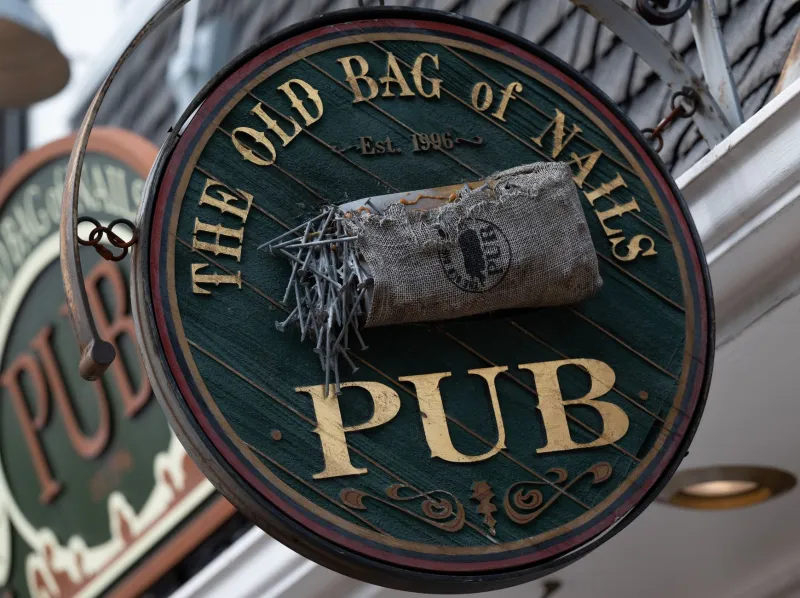
There are two questions every visitor to Chatburn eventually asks. The first is whether Pendle Hill always looks that dramatic (yes, and better in rain). The second, usually gestured upwards with a pint in hand, is: 'Is the cow meant to look like that?'
Yes. And also, sort of no. It depends which decade you're asking about.
The Cow That Came Before the Cow
Ask Denis, who's been drinking here since decimalisation, and he'll tell you the sign hanging today is 'the fourth one, maybe the fifth, lost count after the storm.' He's not far off. Our earliest mention of a hanging sign dates to the 1920s, when the pub apparently displayed a flat wooden cut-out of a brown cow, painted by a joiner from Clitheroe who charged 'one pound and dinner.'
That one lasted until sometime in the sixties, when it was replaced by a painted panel that several regulars insist was 'more of a suggestion of a cow.' Margaret from the post office, who has strong opinions on most things, describes it as 'a brown rectangle with horns. You had to be told it was a cow. But we knew, and that's what mattered.'
The point about pub signs — and this is something sign historians make and pub landlords learn the hard way — is that accuracy was never really the job. The job was being yours. A cow that only a village could love is worth ten handsome ones.
Storm Éowyn and the Great Sideways Incident
The current sign is a proper thing: a shaped board, cast bracket, hand-lettered. It's also the one that spent a memorable January morning hanging at forty-five degrees after a gale came off the hill and swung the bracket clean round.
'I got here at seven,' says our caretaker, Terry, who has looked after the sign longer than anyone will admit. 'Cow facing down the road instead of up it. Half the village thought we'd changed it on purpose. Somebody put it on the village Facebook page before I'd even got the ladder out.'
It took Terry, two regulars, a folding ladder and a thermos most of the morning to set her to rights. The photograph of the sideways cow did the rounds for weeks. One visitor asked if it was 'a seasonal thing.'
The Man Who Offered to Paint Her for a Pint
Every pub sign attracts its artist. Ours turned up on a Tuesday in autumn, a gentleman in a waxed jacket with a portfolio under his arm, who studied the sign for a full five minutes before coming to the bar.
'Your cow,' he said, 'has been overpainted at least three times. I can see the ghost lettering. I'll strip her back and do her properly — for a pint and my lunch.'
He wasn't wrong about the overpainting. Under the current brown there's a darker brown, and under that, according to Terry, 'something green, God help us.' We took him up on it, partially. He cleaned the board, refreshed the lettering and stayed for exactly one pint, which he drank slowly while several regulars offered unsolicited opinions on bovine anatomy. He left saying it was the most reviewed artwork of his career.
What She's Actually For
Here's the thing we only understood properly after the storm: the sign isn't decoration. It's how people give directions ('turn left at the cow'), how kids on the school run mark their progress, how the walking groups from down the Pendle Way know they've arrived. When a coach party stops to photograph her, half the bus gets in the shot. Nobody photographs a photograph of a cow. They photograph our cow.
So she gets washed. Every Sunday morning, warm water and a soft brush, Terry's ritual since before most of the current staff were born. She gets defended, too — there was an incident with a planning officer and a suggestion about 'signage consistency' that ended with the phrase 'she was here before you were' being written, politely, in a formal letter.
Come and Say Hello
Next time you're in, have a look at her on the way out. Notice the slightly wonky horn (the artist's, not the cow's — he ran out of daylight). Notice the ghost lettering if the light's low. She's not perfect. She's not meant to be. She's a brown cow over the door of the Brown Cow, and after a hundred years of repainting, rehanging and ribbing, that's exactly as it should be.
And if you fancy offering an opinion on her anatomy — well, you'll be in good company. Terry's heard them all.